How to Mark the Handoff Between Daily Tasks
Use a simple transition cue to mark where one task ends and another begins, with practical options for busy days, shared spaces, and sudden interruptions.
You finish sorting mail at the dining table, but the unopened envelope stays in your thoughts as you reach for a work document. A transition cue can give that handoff a visible edge without adding a new routine. The useful question is not how to make every moment meaningful; it is which unfinished task keeps following you into the next one.
Which task handoffs need a cue?
Start with a transition that often feels muddled: leaving a work session, moving from household chores to caregiving, or getting ready to rest after a busy evening. Notice what remains physically out of place or mentally unresolved. A cue is most useful when it marks a real boundary, not when it turns every small change into a ceremony.
Choose one action already close at hand. Closing a notebook, putting a tool away, or moving to a different chair can mark an ending. Pair it with a clear next-task marker, such as placing the folder you need on the desk. Keep the sequence short enough to do on an ordinary day.
How do you choose a transition cue?
Use this decision list to see whether a cue fits the moment. Each item connects an observable condition with a choice and an alternative.
- Check the task you are leaving: If its tools can be put away safely, return them to their usual place; if the task must remain open, mark the stopping point with a note instead.
- Check the space you share: If your action will not disrupt another person, use that spot for the handoff; if it will, choose a quiet cue such as closing your notebook.
- Check what happens next: If the next task needs a particular item, place it where you can see it; if you do not know the next task yet, leave the surface clear.
- Check the time available: If a short sequence fits, use it; if an urgent need is waiting, handle that need first and mark the transition afterward.
- Check your body and surroundings: If standing or moving rooms feels comfortable and safe, use that change of place; if not, choose a seated action, such as setting down a pen.
- Check whether the cue adds work: If it takes less effort than the handoff it helps mark, keep it; if it creates another chore, replace it with a simpler action.
What is not worth the effort? Building a separate cue for every email, room change, or cup of tea. Choose one or two handoffs that regularly blur together, and let the rest pass without extra ceremony.
What if a transition cue does not fit today?
A cue should bend when the day changes. An interruption may require immediate attention, a shared room may be occupied, or the usual object may be elsewhere. Skip the sequence when needed; do not treat the missed cue as a failure. If it helps, use a smaller marker once the urgent moment has passed.
Can a transition cue be only one action?
Yes. Closing a file or hanging up an apron can be enough if the action clearly marks an ending for you. A longer sequence is optional, not a requirement.
What if I cannot finish the task I am leaving?
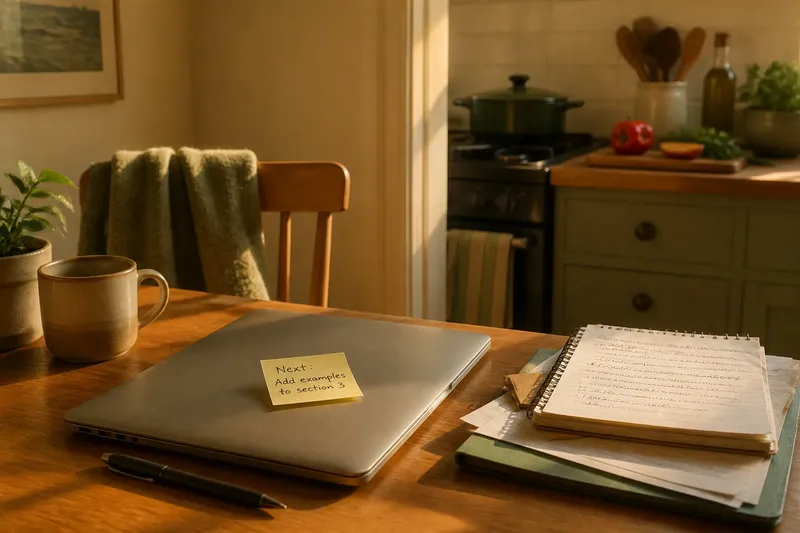
Write down the next action on a sticky note and leave it beside the unfinished materials. The note marks where to resume without requiring you to pretend the task is complete.
Should a cue happen before or after an interruption?
Handle any immediate need first, then use a brief cue if the situation allows. If there is no time, choose a clear stopping point later, such as saving the document and closing the laptop.
How can I tell whether a cue is too complicated?
If you often avoid it or have to gather extra supplies, simplify it. Keep the part that clearly marks the handoff and drop the rest.
How can you work through a handoff?
Say you are leaving a writing task to prepare dinner. Your starting point is a half-finished document on a laptop, notes spread across the table, and a meal that needs attention. First, add a short note in the document naming the next sentence or section to work on. Second, save the file and close the laptop. Third, stack the notes beside it rather than sorting them now. Fourth, move to the kitchen and begin preparing dinner.
The observable result is that the document is saved with a clear return point, the notes remain together, and the kitchen task can begin. If dinner needs attention before those steps are possible, handle it first and return to the document only if there is a suitable moment. The cue marks a practical stopping point; it does not claim that the work feels finished.
When should you change the cue?
Change it when the setting or responsibilities change, or when the action becomes more burden than help. A notebook may work at a desk but not during a shift spent away from one. In that case, a spoken reminder to yourself or a note on the next task can provide a more suitable marker.
Keep the main search phrase, transition cue, in view as a practical choice rather than a rule: it should fit the task, the space, and the people affected. A good handoff leaves you with a recognizable place to stop or resume, even when the day does not unfold as planned.